
Wayne
CDU980E
$211.78
Pros & Cons
Pros
Cons
At a Glance
Overview
The Wayne CDU980E sits at the top of Wayne's CDU submersible line — a 3/4 HP primary sump pump built for basements where a standard 1/3 HP unit simply can't keep up. At $211.78 it costs about $53 more than the 1/2 HP CDU800 and $75 more than the 1/3 HP CDU790 from the same family, and the entire premium buys one thing: water-moving capacity. Wayne publishes a maximum flow of 5,490 gallons per hour, which is roughly double what the class-standard Zoeller M53 (1/3 HP) moves at comparable lift.
That capacity only matters if your pit actually sees that kind of inflow. For a typical basement with occasional seepage, a 3/4 HP pump is overkill — it will empty the pit in seconds and short-cycle, which is hard on the motor and the switch. The CDU980E is the right tool for a specific job: high water tables, flood-prone lots, large drainage footprints, long discharge runs, or pits that fill fast enough during storms that lesser pumps run continuously. If that describes your situation, the published specs and the 5-year warranty make a strong case.
What follows is based on Wayne's published specifications, the CDU980E installation manual, and owner reports — not hands-on testing. Where the details matter (the switch, the pit sizing, the backup pairing), we've flagged the practical implications.
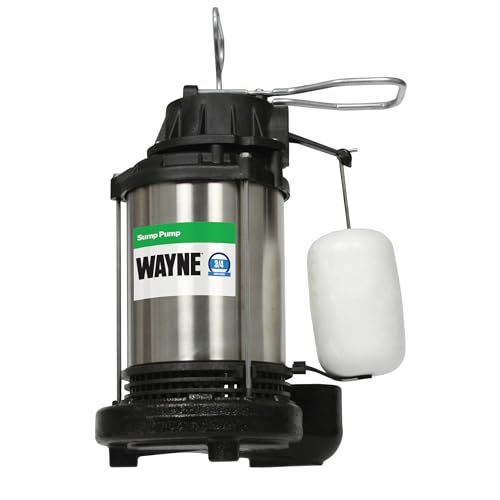
WAYNE CDU980E 3/4 HP Submersible Sump Pump – Cast Iron & Stainless Steel, Vertical Float Switch, 5,490 GPH, 5-Year Warranty
Prices may change · Free shipping with Prime
The Flow Curve — What 5,490 GPH Actually Means in Your Basement
Headline GPH numbers are measured at zero lift, which no real installation has. Wayne's published performance table for the CDU980E is more useful: 5,245 GPH at 5 feet of head, 4,743 GPH at 10 feet, 4,240 GPH at 15 feet, and 3,571 GPH at 20 feet. A typical basement installation — pit to rim, up and out through the foundation wall — runs somewhere between 8 and 12 feet of total head once you account for fittings, so the realistic working number is in the 4,500 GPH neighborhood. That is still an enormous amount of water: roughly 75 gallons per minute.
For context within the same catalog, the 1/2 HP Wayne CDU800 is rated around 3,840 GPH at 10 feet and the 1/3 HP CDU790 around 3,060 GPH, while the Zoeller M53 — the most-recommended 1/3 HP pump on the market — publishes about 2,040 GPH at 10 feet. The CDU980E more than doubles the M53's working capacity. Against premium 1/2 HP options like the Liberty 287 (about 3,420 GPH at 10 feet per its published curve), the Wayne still holds a clear capacity lead at a lower price.
The flip side: capacity you don't use works against you. A pump that empties a pit in five seconds will cycle far more often than one that takes thirty, and every start is the hardest moment in a motor's life. If your inflow is modest, the CDU800 or even the CDU790 will outlast a CDU980E in the same pit simply by cycling less. Buy the 3/4 HP only when the water justifies it.
Top Suction Design — No Weep Hole, No Air Lock
Most submersible sump pumps draw water through a screened intake at the bottom of the unit and require a small weep hole drilled in the discharge pipe to bleed air and prevent air lock. The CDU980E uses Wayne's top suction design instead — the intake pulls water from above the motor — and Wayne states plainly that no weep hole is needed. That eliminates two classic failure points: a weep hole that clogs with mineral scale and causes air lock, and a weep hole that sprays a small fountain inside the pit every cycle.
The impeller is abrasion-resistant glass-reinforced polycarbonate rather than cast iron. That's a deliberate trade: engineered polymer impellers don't corrode and handle fine grit well, but this is still a clear-water pump. The manual is explicit — no sand, mud, grey water, laundry discharge, water softener backwash, or sewage, and using it for any of those voids the warranty. If your pit sees debris or you need solids handling, you're shopping for an effluent or sewage pump, not this one.
One more installation note straight from the manual: rigid discharge piping is required, not flexible hose. A 3/4 HP pump generates enough torque and vibration at startup to walk itself around the pit on flex line, and a wandering pump is how float switches get hung up against the basin wall.
The Vertical Float Switch — Non-Adjustable, Guarded, and the Part to Watch
The CDU980E uses an integrated vertical float switch with a solid polypropylene float, set at the factory to turn on at 9 inches of water and off at 4 inches. It is not adjustable — Wayne warns that modifying it voids the warranty. A float guard shields the switch from debris and from hanging up on the pit wall, and because a vertical float travels straight up and down rather than swinging on an arc, the pump fits in basins as small as 11 inches in diameter where a tethered float would need much more room.
The non-adjustable switch is a real limitation worth understanding. The fixed 9-inch on-level means you cannot raise the activation point for a shallow pit or lower it to build more reserve capacity, and the 5-inch differential between on and off levels means the pump cycles on relatively small volumes. In a high-inflow pit that short differential is fine — the 3/4 HP motor clears it instantly. In a marginal pit it contributes to frequent cycling.
Switch wear is the most common failure mode across all float-switched sump pumps, and owner reports on the CDU line follow that pattern: motors that outlive their switches. Wayne's own manual instructs replacing the float switch roughly every two years as preventive maintenance, and sells the replacement as a service part. That maintenance cadence is worth treating seriously — a failed switch is indistinguishable from a failed pump at 2 a.m. during a storm, and a $30-ish switch on a schedule beats a flooded basement on a surprise.
Motor, Seals, and Build — Where the 5-Year Warranty Comes From
The CDU980E runs a 120V permanent split capacitor (PSC) motor, oil-filled, drawing about 10 amps on the nameplate. PSC motors run cooler and more efficiently than the split-phase motors in cheaper pumps, which matters on a unit that may run continuously through a multi-day storm. The shaft rides on upper and lower ball bearings in a sealed oil bath, and Wayne uses John Crane carbon/ceramic shaft seals — a premium component choice you usually see called out on commercial-grade pumps — behind a cast iron seal plate intended to prevent leaks and galvanic corrosion between the stainless steel motor housing and the cast iron base.
That mixed-material construction — stainless housing over a cast iron base and volute — is the middle path between the full cast iron of a Zoeller M63 and the thermoplastic of budget pumps like the Superior 91250 or the Aquastrong 1 HP. Cast iron where heat and wear concentrate, stainless where corrosion resistance matters. It's assembled in the US with foreign and domestic parts, CSA approved, and backed by a 5-year limited warranty — two years longer than the 3-year coverage on the CDU790, CDU800, Zoeller M53, and Liberty 287, and matched in this catalog only by the M63 (which costs about $100 more).
Practical electrical notes from the manual: the pump needs a grounded, GFCI-protected outlet within reach of its 8-foot cord — extension cords and surge protectors are explicitly prohibited. At roughly 10 amps it will share a 15-amp circuit with little else, and a dedicated circuit is the right answer. Also note the manual states these pumps are not designed for portable generator use, which matters for your outage planning.
Who Should Buy It — and What to Pair It With
The CDU980E fits a specific profile: a sump pit 11 inches or larger in diameter, in a home with genuine high-volume inflow — high water table, flood-zone lot, large or multi-point drainage tile system, or a history of lesser pumps running flat-out through storms. At $211.78 it undercuts premium 1/2 HP cast-iron options like the Liberty 287 ($299.89) and the Zoeller M63 ($311.24) while out-pumping both on paper. If your inflow is moderate, save the money and the motor wear: the CDU800 at $158.78 or the CDU790 at $137.08 are the same design language with saner cycle rates.
Whatever primary you choose, Wayne's own manual recommends an independent high-water alarm or backup pump — and that's doubly true here because the CDU980E's manual says it isn't designed for portable generator power. A battery backup like the Wayne ESP25n or the Basement Watchdog BWSP keeps the pit covered through an outage with no generator involved. If you're on municipal water with adequate pressure, a water-powered backup like the Liberty SJ10 or the Basepump RB750-EZ removes the battery from the equation entirely in exchange for ongoing water usage during operation.
Honest limitations to close: clear water only, a fixed non-adjustable switch, a switch the manufacturer itself treats as a two-year maintenance item, no solids handling, and enough capacity to short-cycle in a modest pit. None of these are hidden flaws — they're the published terms of a high-capacity clear-water pump. Matched to the right basement, the CDU980E is one of the strongest capacity-per-dollar options in the category.
Our Verdict
WAYNE CDU980E 3/4 HP Submersible Sump Pump – Cast Iron & Stainless Steel, Vertical Float Switch, 5,490 GPH, 5-Year Warranty
$211.78
Prices may change · Free shipping with Prime
| Full Specifications | |
|---|---|
| Pump Type | submersible |
| Horsepower | 3/4 HP |
| Flow at 10-ft Head | 4743GPH |
| Switch Type | vertical float |
| Housing | mixed |
| Cord Length | 8ft |
| Discharge Size | 1-1/2 |
| Warranty | 5yr |
Frequently Asked Questions
What size sump pit does the Wayne CDU980E need?
Do I need a check valve with the CDU980E?
What backup pump should I pair with the CDU980E?
What maintenance does the CDU980E require?
How does the CDU980E's warranty compare to other pumps?
Related Buying Guides
Compare With Similar Sump Pumps
Head-to-Head Comparisons
WAYNE CDU980E 3/4 HP Submersible Sump Pump – Cast Iron & Stainless Steel, Vertical Float Switch, 5,490 GPH, 5-Year Warranty
$211.78
Prices may change · Free shipping with Prime