
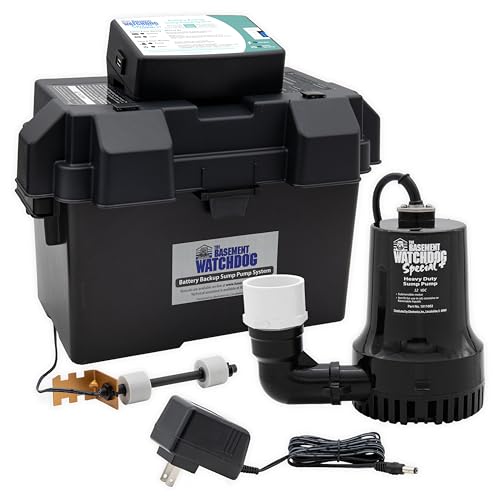
Basement Watchdog
BWSP
$279
Pros & Cons
Pros
Cons
At a Glance
Overview
The Basement Watchdog Special CONNECT (BWSP) is the battery backup that shows up in nearly every conversation about protecting a finished basement on a sane budget. At $279 it's a complete 12-volt DC backup system — pump, dual float switch, monitoring controller, charger, and battery box — from Glentronics, the company that has essentially defined this category for two decades. The one thing it does not include is the battery itself, which is both its biggest hidden cost and the first thing a buyer needs to plan for.
What the BWSP promises is straightforward: when the power dies or your primary pump fails mid-storm, it takes over automatically and keeps the pit from cresting. The published flow curve backs that up — the current listing rates it up to 2,890 GPH at no lift, and the spec table puts it at 1,730 GPH against a realistic 10-foot discharge head. That's within shouting distance of a 1/3 HP AC primary like the Zoeller M53 (2,040 GPH at 10 feet), which is exactly the bar a backup pump needs to clear.
The trade-offs are the usual ones for this category, plus a couple specific to the Watchdog design. The battery is a separate purchase, the included charger is a modest 1.6-amp multi-stage unit, and the warranty is 2 years — shorter than the 3-to-5-year coverage you'll find on quality primary pumps. None of those are dealbreakers, but they shape who this system is right for, and the sections below walk through each one.
The Basement Watchdog Special CONNECT Battery Backup Sump Pump System w/Copper-Wound Motor, 2,890 GPH (BWSP); WiFi-Capable w/Add-on Module
Prices may change · Free shipping with Prime
A Complete Backup System, Not Just a Pump
The first thing to understand about the BWSP is that you're buying a system, not a pump. The box contains the 12V DC submersible pump with a copper-wound motor, a wall-mountable control unit, a microreed dual float switch, battery cables with a 20-amp fuse, a separate plug-in battery charger, and a battery box. The control unit is the brain — it monitors pump, power, and battery conditions around the clock, sounds an audible alarm when something's wrong, and lights a front-panel indicator that tells you which of four problems (battery, fuse, pump, or power) needs attention.
That monitoring layer is what separates a real backup system from a bare DC pump wired to a battery. A backup sump pump spends 99% of its life doing nothing, and the failure mode that actually floods basements isn't a pump that dies dramatically mid-storm — it's a system that quietly went dead months earlier from a corroded terminal, a depleted battery, or a tripped fuse, and nobody noticed. The BWSP's controller exists to catch exactly that, and the manual describes a weekly automatic self-test that exercises the pump so a seized impeller gets flagged before the storm, not during it.
The 'CONNECT' in the name refers to Wi-Fi capability via an add-on module (sold separately) that plugs into the controller's USB data port and pushes alerts to your phone. Worth being precise here: the system is Wi-Fi-capable, not Wi-Fi-equipped. Without the module you still get the full local alarm panel; the module just extends those alerts to your pocket when you're not home to hear the beeper.
Flow Curve: What 1,730 GPH at 10 Feet Actually Means
Backup pump marketing loves zero-head flow numbers because they're big. The BWSP's headline figure — up to 2,890 GPH on the current listing — is measured with essentially no vertical lift, which is not how any basement is plumbed. The number that matters is flow at 10 feet of head, the realistic lift from the bottom of a sump pit to a discharge line exiting above grade. There, the published spec puts the BWSP at 1,730 GPH.
Context makes that number meaningful. The Zoeller M53 — the benchmark 1/3 HP AC primary in our catalog — moves 2,040 GPH at 10 feet. The Wayne CDU980E, a 3/4 HP primary, does 3,500. So the BWSP moves roughly 85% of what a standard 1/3 HP primary moves at real-world head. In a power outage during a heavy storm, that's usually enough to hold the waterline, provided your inflow rate isn't extreme. If your pit fills fast enough that you already run a 1/2 HP or 3/4 HP primary at full capacity during storms, no 12V backup will fully keep pace — that's a physics constraint of battery power, not a BWSP-specific weakness.
Against its direct competitor, the Wayne ESP25n ($337.49), the BWSP is cheaper and posts a comparable at-head flow number — the ESP25n's up-to-2,700-GPH rating is also a zero-lift figure. The BWSP's discharge is 1-1/4-inch, and the kit includes a PVC adapter to plumb into standard 1-1/2-inch discharge pipe, per the installation manual. You'll supply the rigid PVC, fittings, and check valve(s) yourself.
The Dual Float Switch: Redundancy at the Failure Point
Ask any plumber what kills sump pumps and the answer is almost never the motor — it's the switch. Float switches cycle thousands of times a year, get fouled by debris, snag on pit walls and discharge pipes, and their mechanical contacts wear or weld. It's the single most common failure point in any sump installation, primary or backup.
Basement Watchdog's answer is the microreed dual float switch: two independent floats on one bracket. If the lower float fails to trigger, the upper float activates the pump as water keeps rising. It's a simple, mechanical redundancy that doesn't rely on electronics to save you, and it's genuinely differentiated from the single-sensor setups on cheaper backup units. The reed-switch design itself is a proven mechanism — Glentronics notes the technology has decades of service history in other applications before they brought it to the pump industry.
The honest caveat: a dual float doubles your protection against switch failure, but it doesn't eliminate the installation sensitivity that causes float problems in the first place. The manual is explicit about positioning — the float must hang free of the pit wall, the primary pump, and the discharge pipe, with the controller and battery connections kept dry and at least four feet off the floor. A backup pump whose float snags during installation is a backup pump that doesn't exist. Follow the manual's mounting diagrams, including the narrow-pit options, and test the switch with a bucket of water before you call the job done.
Battery, Runtime Math, and the True Cost of Ownership
Here's the math every BWSP buyer needs to do before checkout. The $279 system price does not include a battery. The manual specifies a Basement Watchdog maintenance-free AGM standby battery (model BW-27AGM) or equivalent deep-cycle standby battery, and is unambiguous that automotive batteries are not acceptable — car batteries are built for short cranking bursts, not sustained pump loads, and will die quickly in this service.
On runtime, the manual's own figures: the standard standby battery is rated for a minimum of 7.5 hours of continuous pumping. Since a sump pump in a real storm cycles on and off rather than running flat-out, the manual frames practical endurance at a 10% duty cycle — roughly six minutes of pumping per hour — where the newer AGM standby batteries are rated around 50 hours of storm coverage, and the larger 'Big' standby battery around 100 hours. The pump is relatively gentle on the battery, drawing in the neighborhood of 10 amps under load per retailer spec sheets, which is why the modest 1.6-amp multi-stage charger is adequate to maintain the battery between events. The system also supports wiring two matched batteries in parallel (same age, type, and capacity, per the manual) to roughly double runtime — a legitimate upgrade path for storm-prone regions.
Total cost of ownership, then: $279 for the system, plus a standby battery, plus eventual battery replacement every few years (lead-acid and AGM standby batteries are consumables with a finite service life, typically quoted in the five-to-seven-year range for standby duty). Budget for all of it. The Wi-Fi CONNECT module is optional. Even fully loaded, the package usually lands well under the cost of one insurance deductible for a flooded finished basement — which is the comparison that actually matters.
Where the BWSP Fits — and Where It Doesn't
The BWSP's sweet spot is the homeowner with a standard sump basin, a working AC primary, moderate inflow, and a basement worth protecting — especially if it's finished. Its compact pump body and the manual's documented narrow-pit installation options (an offset L-bracket arrangement) make it one of the easier backups to squeeze into a crowded pit next to an existing primary. Pair it with a quality primary like the Wayne CDU800 or Zoeller M53 and you have a complete belt-and-suspenders setup for under $500 before the battery.
Where it doesn't fit: homes on wells or with chronic multi-day outage risk should look hard at water-powered backups instead — the Basepump RB750-EZ or Liberty SJ10 run indefinitely on municipal water pressure with no battery to maintain, at the cost of ongoing water usage during operation and a hard requirement for adequate city water pressure. The BWSP's runtime is finite by definition; a water-powered unit's is not. Conversely, if you're on a well, a water-powered backup is useless the moment the power (and your well pump) dies — battery is your only option, and the BWSP is a strong one.
The limitations to weigh: the 2-year warranty is the shortest coverage in its competitive set, the battery is an extra purchase with its own replacement cycle, and the 1.6-amp charger means a deeply depleted battery takes a long time to recover — if a storm drains the battery on day one and power stays out, recharging isn't happening until the grid comes back anyway, but a short outage followed by another storm can catch a half-charged system. And to state the obvious: this is a backup, not a primary. If you need a main pump, buy a main pump — the BWSP's job is to be the one that works when everything else doesn't.
Our Verdict
The Basement Watchdog Special CONNECT Battery Backup Sump Pump System w/Copper-Wound Motor, 2,890 GPH (BWSP); WiFi-Capable w/Add-on Module
$279
Prices may change · Free shipping with Prime
| Full Specifications | |
|---|---|
| Pump Type | battery-backup |
| Horsepower | — |
| Flow at 10-ft Head | 1730GPH |
| Switch Type | vertical float |
| Housing | — |
| Cord Length | — |
| Discharge Size | 1-1/4 |
| Warranty | 2yr |
Frequently Asked Questions
Does the Basement Watchdog BWSP come with a battery?
Will the BWSP fit in my sump pit next to my primary pump?
Do I need a check valve with the BWSP?
Can the BWSP replace my primary sump pump?
Is the Wi-Fi monitoring built in?
Related Buying Guides
Compare With Similar Sump Pumps
Head-to-Head Comparisons
The Basement Watchdog Special CONNECT Battery Backup Sump Pump System w/Copper-Wound Motor, 2,890 GPH (BWSP); WiFi-Capable w/Add-on Module
$279
Prices may change · Free shipping with Prime