
Wayne
ESP25n
$337.49
Pros & Cons
Pros
Cons
At a Glance
Overview
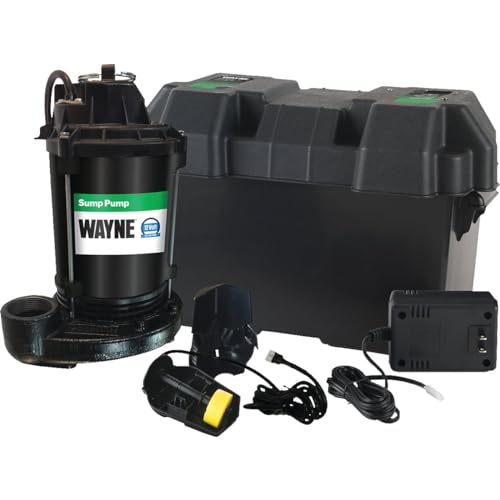
The Wayne ESP25n is the battery backup sump pump that shows up in nearly every conversation about protecting a basement when the power goes out. It's a dedicated 12-volt DC backup — not a combination system, not a water-powered unit — designed to sit alongside your existing primary pump and take over when the grid fails or the primary pump quits. At $337.49 for the pump and controller (battery not included), it sits in the middle of the backup-pump market: more than the Superior Pump 91250 utility-pump-as-backup approach, less than a full combination system, and right in line with the Basement Watchdog BWSP at $279 once you factor in the battery.
What the ESP25n's published specs tell you is that Wayne engineered it as a genuine pump, not a token trickle device. The manufacturer-published flow curve runs 2,700 GPH at 0 ft of head, 2,100 GPH at 5 ft, 1,500 GPH at 10 ft, and 660 GPH at 15 ft — numbers that put it within reach of many 1/4 to 1/3 HP primary AC pumps at typical residential lift heights. The housing is epoxy-coated steel with a cast iron base and a thermoplastic impeller, the discharge is a full 1-1/2 in. NPT, and the controller includes an audible alarm and LED status display. Based on the manual and Wayne's published documentation, this is a backup you can pair with a serious primary like the Wayne CDU980E or Zoeller M53 without feeling like the weak link.
The honest caveats are equally clear from the documentation. The battery is not included — Wayne recommends its own 75 amp-hour AGM unit (model WSB1275), which adds meaningful cost to the system price. The unit is rated for indoor use only, the warranty is 2 years (shorter than the Zoeller M63's coverage on the primary side), and like every battery backup ever sold, its runtime is only as good as the battery you feed it and the state of that battery when the storm hits. This review breaks down the flow numbers, the battery math, the installation requirements, and how the ESP25n stacks up against the Basement Watchdog BWSP and the water-powered Liberty SJ10.
WAYNE ESP25n - 12 Volt Battery Back Up Sump Pump, Battery Not Included - Up to 2,700 Gallons Per Hour
Prices may change · Free shipping with Prime
Flow Curve: What 2,700 GPH Actually Means at Real Lift Heights
Manufacturer flow ratings are quoted at 0 ft of head, which is not how sump pumps are used. The ESP25n's published curve — 2,700 GPH at 0 ft, 2,100 GPH at 5 ft, 1,500 GPH at 10 ft, and 660 GPH at 15 ft — is the useful way to read it. Most basements lift water 8 to 10 ft to the discharge exit, which means the realistic working number is around 1,500 GPH, or 25 gallons per minute. That's roughly the output of a decent 1/4 HP primary pump, and it's enough to keep pace with moderate to heavy inflow in a typical residential pit.
For context within the catalog: the Wayne CDU980E primary moves about 4,600 GPH at 10 ft, and the Zoeller M53 handles roughly 2,580 GPH at 10 ft. So the ESP25n at 1,500 GPH won't match a strong primary gallon-for-gallon — it's not supposed to. Its job is to hold the line during an outage, and at 25 GPM it will keep up with all but the most extreme inflow events. If your pit fills frighteningly fast during storms even with the primary running, the better move is a bigger primary plus this backup, not expecting the backup to do primary work.
One practical note from the manual: smaller-diameter discharge piping reduces flow rate and performance. The pump ships with a 1-1/2 in. NPT discharge, and stepping down to 1-1/4 in. pipe with an adapter is allowed but costs you capacity. If you're plumbing a dedicated discharge line for the backup, keep it 1-1/2 in. rigid PVC with minimal elbows — every turn erodes the curve you're paying for.
Battery System and Runtime Math: The Real Cost of Ownership
The ESP25n is sold without a battery, and the battery is not a corner to cut. The system is designed for a single 12-volt deep-cycle battery, and Wayne's documentation is explicit that AGM batteries are the most efficient pairing — the included oversize battery case accepts up to a Group 27-frame AGM. Wayne recommends its own WSB1275 75 amp-hour battery. Owner reports and installer guidance broadly align: a quality 75Ah-class deep-cycle AGM is the floor, and bigger capacity (Group 27 or Group 31 frames, where the case and budget allow) buys proportionally more runtime.
Wayne's published marketing claims up to 26 hours of protection and up to 10,000 gallons pumped on a single charge. Treat those as best-case manufacturer numbers built on intermittent cycling — a pump that runs 10 seconds every few minutes lasts dramatically longer than one running continuously against heavy inflow. The honest way to think about runtime is duty cycle: at 1,500 GPH under continuous load at 10 ft of head, a 75Ah battery is measured in hours, not days; under typical storm cycling (the pump kicking on every minute or two), a healthy 75Ah battery covering an overnight outage is a reasonable expectation based on owner reports.
The controller handles charging automatically and reports status through an LED display, with an audible alarm that sounds when the backup activates or when there's a battery or system fault. That alarm is your only notification — unlike the WiFi-capable Basement Watchdog BWSP, the ESP25n has no remote alerting. If you're frequently away from home during storm season, that distinction matters. Also budget for battery replacement every 3 to 5 years; AGM batteries degrade whether they cycle or not, and the battery is the consumable heart of this system.
Construction, Switch, and Installation Requirements
Per Wayne's published spec sheet, the ESP25n uses an epoxy-coated steel housing with a cast iron base and a corrosion-resistant thermoplastic impeller — a mixed-material build that mirrors what Wayne does on its primary pumps like the CDU790 and CDU800. The cast iron base adds ballast and durability where the pump sits in the pit; the thermoplastic impeller is the standard trade in this class, trading ultimate abrasion resistance for corrosion immunity and flow efficiency. The pump is fully submersible and rated for clear water only, indoor use, in sump basins 16 in. in diameter or larger.
The switch is a vertical float that mounts to the discharge pipe with a hose clamp. The manual specifies positioning it 10 to 12 in. above the pit floor — deliberately above the primary pump's normal on-level, so the backup only activates when water rises past where the primary should have caught it. Vertical floats are the right choice for backup duty: they don't wander around the pit like a tethered float, and they fit in narrow basins alongside a primary. The known failure modes are debris jamming the float and the float being set too low (backup fights the primary) or too high (water reaches the rim before activation). Set it per the manual and test it by filling the pit with the primary unplugged, exactly as the installation instructions direct.
Plumbing has two approved paths. Method 1 (Wayne's preference) is a separate dedicated discharge line with its own check valve. Method 2 ties into the primary's discharge through a wye fitting, and the manual is unambiguous that this requires a check valve in BOTH the primary and backup lines to prevent recirculation. Rigid PVC or metal pipe is required — flex hose is explicitly prohibited for permanent installation. The check valve is sold separately, which is a small but real extra cost. Neither method is difficult for a competent DIYer, but the two-check-valve requirement on shared discharges is the step people most often skip and later regret.
ESP25n vs Basement Watchdog BWSP vs Liberty SJ10
These are the three backup philosophies in the catalog, and the ESP25n's position becomes clear against them. The Basement Watchdog BWSP ($279) is the closest direct competitor: also a 12V battery backup, also sold without a battery included in its headline price comparison, pushing 1,730 GPH at 10 ft versus the ESP25n's 1,500 GPH. The BWSP's edge is its monitoring controller — 24-hour battery and system watchdog functions plus WiFi capability with an add-on module for remote alerts. The ESP25n's counter is Wayne's pump pedigree, a heavier cast-iron-based build, and a flow curve that holds up respectably despite the lower 10-ft number (the ESP25n actually rates higher at 0 ft: 2,700 vs the BWSP's 2,890 — near enough that real-world difference is in the noise).
The Liberty SJ10 ($206.92) is the water-powered alternative: no battery at all, no charger, no runtime limit — it runs off municipal water pressure as long as the water mains hold. For homes on reliable city water with adequate pressure, the SJ10 eliminates the entire battery-maintenance burden the ESP25n carries. But it requires sufficient municipal pressure (it's useless on well water, since well pumps die in the same outage that kills your primary), it consumes water to pump water, and its output is generally lower than a battery unit's. The SJ10 is the set-and-forget pick for city-water homes; the ESP25n is the pick for well-water homes or anyone whose inflow demands more GPH than a water-powered unit delivers.
The third path worth naming: Wayne sells the ESP25n as half of the WSS30VN combination system, pre-plumbed with a CDU800 primary through a shared wye. If you're replacing a dead primary anyway and want one discharge connection, the combination system is worth pricing against buying the CDU800 and ESP25n separately. If your primary is healthy, the standalone ESP25n reviewed here is the right purchase.
Honest Limitations and Who Should Skip It
Start with the true installed cost. The $337.49 catalog price buys the pump, controller, charger, float switch, and battery case — but not the battery, not the check valve(s), and not the PVC. A quality 75Ah AGM battery runs the total up substantially, and battery replacement every 3 to 5 years is a recurring cost the water-powered Liberty SJ10 never incurs. Buyers comparing headline prices alone consistently underestimate this.
The notification story is weak by 2026 standards. The audible alarm and LED panel only help if someone is home to hear them. There's no built-in WiFi, no app, no self-testing cycle that reports to your phone — the Basement Watchdog BWSP's monitoring controller is genuinely ahead here. Owner reports also surface the universal float-switch complaints: floats set at the wrong height, and occasional switch failures that only get discovered during a storm if the homeowner never ran the manual's fill-the-pit test. That's not unique to Wayne, but it's the most common way these systems fail in the field.
Finally, the 2-year warranty is adequate but not generous — Zoeller puts longer coverage on its primary pumps, and the battery itself typically carries only a 1-year warranty from battery makers. And the system is a backup only: it cannot serve as your primary pump, it's indoor-rated only, and it protects against exactly two failure modes (power outage and primary-pump death). If your real problem is chronic extreme inflow, spend the money on a bigger primary like the Aquastrong 1HP or Zoeller M63 first, then add the ESP25n as the second layer it was designed to be.
Our Verdict
WAYNE ESP25n - 12 Volt Battery Back Up Sump Pump, Battery Not Included - Up to 2,700 Gallons Per Hour
$337.49
Prices may change · Free shipping with Prime
| Full Specifications | |
|---|---|
| Pump Type | battery-backup |
| Horsepower | — |
| Flow at 10-ft Head | 1500GPH |
| Switch Type | vertical float |
| Housing | mixed |
| Cord Length | — |
| Discharge Size | 1-1/2 |
| Warranty | 2yr |
Frequently Asked Questions
What size sump pit does the Wayne ESP25n need?
What battery should I buy for the ESP25n, and is one included?
Do I need a check valve with the ESP25n?
How do I maintain and test the ESP25n?
What warranty does the ESP25n carry, and what does it pair with?
Related Buying Guides
Compare With Similar Sump Pumps
Head-to-Head Comparisons
WAYNE ESP25n - 12 Volt Battery Back Up Sump Pump, Battery Not Included - Up to 2,700 Gallons Per Hour
$337.49
Prices may change · Free shipping with Prime