
Liberty Pumps
287
$299.89
Pros & Cons
Pros
Cons
At a Glance
Overview
The Liberty Pumps 287 is the pump that comes up when you ask a plumber — not a reviewer, a plumber — what they'd put in their own basement. It's a 1/2 HP cast-iron submersible from Liberty's 280-Series, built in Bergen, New York around a one-piece 'Uni-Body' casting and a magnetically operated vertical float switch. At $299.89 it costs roughly $100 more than the ubiquitous Zoeller M53 and nearly double the Wayne CDU800, so the entire question this review has to answer is whether the engineering justifies the premium.
Based on Liberty's published spec sheet and the 280-Series engineering bulletin, the case for the 287 rests on three things: a 1/2 HP motor that moves a published 3,420 GPH at a realistic 10-foot lift, a vertical magnetic float (VMF) switch that works in pits as narrow as 10 inches, and a build quality — one-piece cast housing, 416 stainless shaft, permanently lubricated ball bearings, quick-disconnect cord — that reads more like a light-commercial pump than a big-box residential one. Owner reports across plumbing forums and retailer reviews consistently describe these running a decade or more with nothing but occasional float maintenance.
The honest caveat is the switch. The VMF is compact and reliable, but its on/off differential is fixed at the factory (turn-on around 9-1/2 inches, turn-off around 4 inches) and it has a known weakness in hard-water regions: mineral buildup on the float rod can stick the float on or off. Buyers with very high inflow, an effluent application, or aggressive iron/calcium water should read the switch section carefully before committing. For a standard clear-water basement sump, the 287 is one of the strongest primary-pump picks in this catalog.
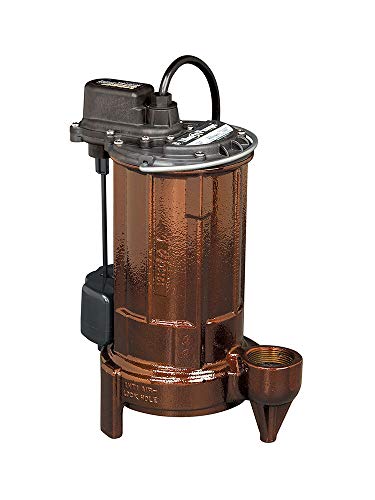
Liberty Pumps 287 1/2-Horse Power 1-1/2-Inch Discharge 280-Series Automatic Submersible Sump Pump with VMF Switch
Prices may change · Free shipping with Prime
The VMF Switch — Compact, Magnetic, and Not Adjustable
The defining feature of the 287 is its Vertical Magnetic Float switch. Instead of a mechanical arm or a tethered ball, a float slides up and down a fixed vertical rod and trips the motor magnetically when it rises. Because the float travels straight up rather than swinging in an arc, the pump operates in a sump as narrow as 10 inches in diameter — a real advantage in older homes with undersized pits, where a tethered float like the one on budget pumps can hang up on the pit wall or the discharge pipe and either flood the basement or run the pump dry.
The trade-off is adjustability. The VMF's switch points are factory-set — a turn-on level of roughly 9-1/2 inches and turn-off around 4 inches — and cannot be changed. That 5-1/2-inch differential is short, which means in a high-inflow storm the pump cycles frequently. Liberty's own literature flags this directly: VMF models (257, 287, 297) are not recommended for effluent applications precisely because of the short on/off cycle, and a larger-diameter basin is preferred because it lengthens each cycle and reduces switch wear. If your pit sees sustained heavy inflow, a wide-angle float model like the Liberty 283, or a beefier vertical-float unit like the Zoeller M63, tolerates the duty better.
The documented failure mode is mineral fouling. In water with heavy calcium carbonate, scale builds on the float rod until the float sticks — either failing to rise (pump never starts) or sticking up (pump runs continuously). Owner guidance, echoed by pump retailers, is to periodically clean the rod and float with a vinegar solution. It's a five-minute maintenance task, but it's not optional in hard-water areas, and it's the single most common complaint pattern in long-term owner reports. If your water is aggressive, budget for that chore or choose a switch design that's less sensitive to scale.
Flow Performance at a Realistic Basement Lift
Spec-sheet GPH numbers are usually quoted at zero lift, which no basement installation actually sees. The figure that matters is flow at 10 feet of head — a typical basement floor-to-discharge height — and Liberty publishes 3,420 GPH (57 GPM) there for the 287. The performance curve tops out at a 37-foot shut-off head, so there's comfortable margin even for deep basements with long discharge runs and a couple of elbows adding friction loss.
That 10-foot number puts the 287 meaningfully ahead of the 1/3 HP class. The Zoeller M53, the default recommendation at the $200 price point, is a fine pump but moves substantially less water at the same lift. If you need more flow than the 287 offers, the step up in this catalog is the Wayne CDU980E at 3/4 HP — more gallons per dollar at $218.65, though with a different switch design and a shorter track record of decade-plus service in owner reports. The Wayne CDU800 matches the 287's 1/2 HP class on paper for about $140 less, but its build (mixed materials, conventional float) isn't in the same tier as the Liberty's all-cast-iron Uni-Body.
Electrical draw matters for anyone pairing this pump with a backup or an inverter. Liberty's bulletin rates the 1/2 HP motor at 8.5 running amps on 115V, and the OEM manual documents a locked-rotor amperage around 23A at startup — roughly 2,600 watts of surge. Any generator, power station, or battery-backup inverter intended to carry the 287 needs to handle that inrush, not just the ~980-watt running load. This is standard 1/2 HP motor behavior, not a defect, but it's the spec people undersize.
Uni-Body Construction — Where the Premium Goes
Open the 280-Series bulletin and the build sheet explains the price. The motor housing is a single cast-iron 'Uni-Body' casting, which eliminates the seal ring between a separate motor housing and pump body — one less gasket to fail, and one less joint to transmit vibration. The finish is epoxy powder coat. The rotor shaft is 416 stainless steel, the fasteners are stainless, and the bottom intake screen is a removable stainless piece you can actually pull and clean. The impeller is a vortex design rated to pass 3/4-inch solids, so the occasional small stone or debris that washes into the pit won't jam it the way it would a close-tolerance non-clog design.
The motor itself is oil-filled, hermetically sealed, thermally protected, and spins at 3,450 RPM on permanently lubricated upper and lower ball bearings — no greasing, no oiling, nothing on the maintenance schedule for the motor itself. At 29 pounds the 287 is substantially heavier than thermoplastic competitors, and that mass plus the one-piece casting is why owners consistently describe it as one of the quietest pumps they've run. For finished basements where the pit sits under a bedroom or office, that matters more than any flow number.
The genuinely underrated feature is the quick-disconnect 10-foot power cord. The cord plugs into the motor cap and can be swapped in seconds without breaking any motor seals. Cords get nicked during installation, chewed by rodents, or damaged during other basement work; on most pumps a bad cord means a shop repair or a new pump. On the 287 it's a part you replace yourself. Longer cords are available from the factory as suffixed variants if your outlet is far from the pit.
Pit Fit, Installation, and the Details That Bite People
The 287 needs a minimum 10-inch-diameter sump and, per Liberty's guidance, a basin at least 18 inches deep — though the manufacturer itself notes a larger-diameter basin is preferred because it lengthens pump cycles and reduces float-switch cycling. The pump stands 13 inches tall and about 10 inches across at its widest point, so measure your pit before ordering, especially the depth from the pit floor to any cover. The discharge is 1-1/2-inch NPT, the residential standard, so it threads directly onto typical 1-1/2-inch PVC discharge plumbing.
Two installation details come straight from the manual and are the ones DIY installers most often skip. First, install a check valve on the discharge line — without one, the water column in the pipe falls back into the pit at the end of every cycle, the pump re-pumps the same water, and the switch short-cycles itself to an early death. Second, Liberty's manual calls for a small air-bleed (weep) hole drilled in the discharge pipe below the check valve to prevent airlock; skip it and the pump can spin against a trapped air pocket and move no water while sounding perfectly healthy.
The fixed switch levels deserve one more mention in the pit-fit context. Because turn-on is set around 9-1/2 inches, the standing water level in your pit will sit higher between cycles than it would with a tether switch you can adjust. In a shallow pit that's fine. In a pit where the inlet tile enters low, confirm the turn-on level sits comfortably below the inlet so you're not holding water back into the drain tile between cycles.
Liberty 287 vs Zoeller M53 vs Wayne CDU980E
These three are the shortlist this catalog's readers actually cross-shop, and the published specs draw a clean map. The Zoeller M53 (~$200) is the value incumbent: 1/3 HP, cast iron, a proven vertical float, and a reputation for durability that matches Liberty's. It gives up flow at 10 feet and the M53's build, while good, doesn't include the Uni-Body casting or quick-disconnect cord. For a moderate-inflow basement on a budget, the M53 remains the rational pick; the 287 is the buy when inflow is heavier or the pit is tight. The Zoeller M63 (~$300) is the closer head-to-head — premium 1/3 HP build with a 5-year warranty — and the choice between M63 and 287 comes down to whether you value the Liberty's extra horsepower or the Zoeller's longer warranty and adjustable-free reputation.
The Wayne CDU980E ($218.65) wins the pure capacity-per-dollar argument at 3/4 HP and is the right answer for genuinely high inflow. The reasons to still pay more for the 287 are the cast-iron Uni-Body, the magnetic vertical float's small-pit fit, and Liberty's service track record. The budget end of the catalog — the Superior 91250 at $76.39 — isn't a real alternative here; it's a 1/4 HP thermoplastic utility pump that belongs in a different conversation entirely.
Whatever primary you choose, it needs a backup, because every one of these is a corded AC pump that stops when the power does. Liberty's own SJ10 is a water-powered backup that runs off municipal pressure — excellent for city-water homes, useless on a well. For well-water homes, the battery options in this catalog are the Basement Watchdog BWSP or the Wayne ESP25n; either covers a power outage, and the 287's documented ~23A startup surge is the number your backup's inverter (or a combo system) has to respect.
Our Verdict
Liberty Pumps 287 1/2-Horse Power 1-1/2-Inch Discharge 280-Series Automatic Submersible Sump Pump with VMF Switch
$299.89
Prices may change · Free shipping with Prime
| Full Specifications | |
|---|---|
| Pump Type | submersible |
| Horsepower | 1/2 HP |
| Flow at 10-ft Head | 3420GPH |
| Switch Type | vertical float |
| Housing | cast iron |
| Cord Length | 10ft |
| Discharge Size | 1-1/2 |
| Warranty | 3yr |
Frequently Asked Questions
Will the Liberty 287 fit in my sump pit?
Do I need a check valve with the Liberty 287?
What backup pump should I pair with the Liberty 287?
How do I maintain the VMF float switch?
What does the 3-year warranty cover?
Related Buying Guides
Compare With Similar Sump Pumps
Head-to-Head Comparisons
Liberty Pumps 287 1/2-Horse Power 1-1/2-Inch Discharge 280-Series Automatic Submersible Sump Pump with VMF Switch
$299.89
Prices may change · Free shipping with Prime